


PSG x NFL Capsule Revisits Iconic "Vuitton" Pattern From 2006
Posted 2026.10.19
Nikefootball+
Welcome back to The Vault°, our weekly look at the artifacts, moments, and untold stories that shaped the culture.
SHOP AIR MAX ON NIKE.COMBefore it became a design language, Air started as a performance solution.
In the late 1970s, aerospace engineer Marion Frank Rudy developed a cushioning system built around pressurized air, designed to absorb impact without breaking down like traditional foam. After being turned away by several companies, Rudy brought the idea to Nike. Phil Knight and the brand’s internal team saw potential immediately, and early prototypes were handed to runners for testing. What they found was simple: the cushioning held up significantly longer, maintained consistency under stress, and offered a different underfoot sensation than anything else on the market at the time. By the end of the decade, Air had quietly become embedded in Nike’s performance lineup of running shoes.
Through the early 1980s, the technology remained largely hidden. It was present in models like the Tailwind, but it wasn’t something consumers could see — or fully understand. That changed in 1987, when Tinker Hatfield introduced the Nike Air Max 1.

Drawing inspiration from Paris’ Centre Pompidou — a building that famously exposes its internal structure — Hatfield made the decision to cut away the midsole and reveal the Air unit. It was a controversial move internally, with concerns around durability and consumer perception, but it ultimately redefined how performance tech could be presented. The Air Max 1 didn’t just perform differently; it looked different. That shift turned cushioning into a visual identity, created a hysterical culture, and helped define the future of Nike Air Max shoes.
From there, the line evolved rapidly, with each model building on the last while introducing its own point of difference. The Air Max 90 refined the original formula with sharper lines and increased Air visibility. The Air Max 93 expanded the window further, while the Air Max 95 — now often associated with the Big Bubble era — introduced visible forefoot Air and drew inspiration from human anatomy, from muscle fibers to the spine. The Air Max 97 followed with full-length Air cushioning, wrapped in a rippling upper inspired by high-speed trains, marking another major leap forward in both design and tech.
Into the late ‘90s and early 2000s, models like the Air Max Plus brought tuned Air to the forefront, becoming a staple in regions like the UK and Australia, while the Air Max 360 removed foam entirely in favor of a full Air platform. More recently, models like the Nike Air Max 270 and Nike Air Max DN have continued to push the category forward, blending performance tooling with lifestyle-first design. Across each generation, the core idea remained intact, but the execution continued to shift.

Over time, Air Max moved well beyond performance running. It found a foothold in music, streetwear, and regional subcultures — from London’s embrace of the Air Max 95 and Air Max Plus, to its presence across hip-hop and global fashion. What started as a technical innovation became a cultural one.
March 26 — Air Max Day — now serves as the annual marker for that legacy. Each year, Nike revisits key models like the Air Max 90 and Air Max 95, introduces new interpretations, like this year's Nike Air Liquid Max, and reinforces the lineage that began in 1987. While the day itself isn’t built around collaborations, partnerships have become a key part of how the line continues to evolve throughout the remaining months of the year. They offer new perspectives on familiar silhouettes, often bridging different scenes, cities, and creative disciplines.
With that in mind, this Vault° feature looks back at some of the most important Air Max collaborations ever released — projects that didn’t just add new colorways, but helped shape how the line is viewed today.
RELEASED: 2018
Emerging from Nike’s Vote Forward campaign, Sean Wotherspoon’s Air Max 1/97 quickly became one of the most influential collaborations of the modern era. The design fused two iconic silhouettes, pairing the Air Max 97’s upper with the Air Max 1 sole, but it was the material execution that set it apart. Multi-colored corduroy panels, frayed edges, and vintage-inspired detailing gave the shoe a thrifted, DIY feel that resonated with a new generation of collectors. Its success extended well beyond release day, helping push hybrid models and storytelling-led design further into the mainstream.

RELEASED: 2021-
Patta’s “Waves” pack didn’t just apply new colors — it altered the DNA of the Air Max 1. By reshaping the mudguard into a flowing, wave-like pattern, Patta introduced a new visual identity for the silhouette that felt both subtle and transformative. Released across multiple colorways, the pack balanced bold palettes with wearable blocking, reinforcing Patta’s long-standing connection to the Air Max line. It also marked a moment where collaborative design went beyond materials and into structural reinterpretation.

RELEASED: 2017
Part of Virgil Abloh’s “The Ten” collection, the OFF-WHITE Air Max 90 recontextualized the silhouette through a deconstructed lens. Panels were peeled back, stitching was exposed, and signature text elements were applied across the upper, turning the Air Max 90 into something closer to a design study than a standard release. The black and white colorways offered two distinct interpretations — one bold, one stripped back — but both carried the same conceptual weight. The project had a lasting impact on how collaborations approached transparency and process.

Released: 2005
Parra’s 2005 Air MAx 1 collab stands as one of the earliest examples of artist-led storytelling within the Air Max line, arriving at a time when collaborations were far less common and far less formulaic. Designed by Dutch artist Piet Parra, the pair drew directly from the tones of his hometown, blending burgundy, pink, and soft earth hues to reflect Amsterdam’s cityscape—particularly its brick architecture, evening skies, and muted urban palette. Unlike many releases of the era that leaned on simple color blocking, Parra introduced layered textures and unexpected color transitions, giving the Air Max 1 a distinctly artistic identity that felt closer to a canvas than a performance runner
Released in extremely limited quantities through select European retailers, the sneaker quickly became one of the most sought-after Air Max collaborations ever, cementing Parra’s place in Nike’s creative circle. Nearly two decades on, the Parra x Nike Air Max 1 “Amsterdam” remains a benchmark for how collaborations can extend beyond branding—offering a clear point of view, rooted in place, culture, and individual artistry.

Released: 2002
The atmos “Safari” Nike Air Max 1 remains one of the earliest examples of a collaboration redefining a silhouette through texture. Originally released in 2002, the design borrowed the safari print from Nike’s archives (also designed by Tinker Hatfield) and applied it to the mudguard, pairing it with earthy tones and vibrant accents. At a time when collaborations were still developing their identity, atmos delivered a pair that felt both experimental and cohesive, setting a precedent for future boutique-driven projects.

Released: 2017
Virgil Abloh’s take on the Nike Air VaporMax built on the silhouette’s already futuristic foundation. By adding translucent uppers, exposed foam, and his now-signature text placements, Abloh emphasized both the construction and the concept behind the shoe. The all-black colorway, in particular, leaned into wearability while maintaining its experimental edge, helping position the Nike Air VaporMax as more than just a performance runner within the broader Nike Air Max ecosystem.
SHOP AIR MAX ON NIKE.COM
Released: 2005 Cancelled
The Parra x Nike Air Max 1 “Albert Heijn” stems from the same 2005 project that produced the now-iconic “Amsterdam” pair, with Nike commissioning Dutch artist Piet Parra to create two designs celebrating his hometown. While the “Amsterdam” release would go on to reach legendary status, this second concept took a more localized route, drawing inspiration from the Netherlands’ most recognizable supermarket chain, Albert Heijn.
Built around the retailer’s signature blue-and-white palette, the design translated everyday branding into a crisp, wearable Air Max 1. However, the pair never made it to retail. Shortly before its planned launch, Albert Heijn updated its branding and shopping bag colors, prompting Nike to cancel the release entirely. Most pairs were destroyed, with just 24 surviving—reportedly distributed among Parra’s friends and family—cementing the “Albert Heijn” as one of the rarest and most elusive Air Max collaborations ever produced.

Released: 2025
The Zellerfeld x Nike Air Max 1000 points to a new direction for the Air Max line, shifting away from traditional construction toward fully digital design. Produced using Zellerfeld’s 3D-printing process, the silhouette is formed as a single, sculpted piece, removing the need for layered materials and stitched panels. It’s a clear departure from the material-driven builds that have defined Air Max for decades, offering a more streamlined, tech-focused approach.
Visually, the design leans into fluid, organic shaping, with lattice structures replacing conventional overlays and support systems. Rather than relying on visible Air units in the traditional sense, the concept integrates cushioning and structure directly into the form itself, suggesting a future where Air Max evolves beyond its original framework and into something entirely new.

RELEASED: 2006 + 2021
CLOT’s “Kiss of Death” is one of the most concept-driven Air Max collaborations to date. First released in 2006, Edison Chen's design incorporated translucent panels that revealed anatomically inspired graphics beneath, referencing the human foot. Combined with premium materials and subtle detailing, the shoe blurred the line between design and storytelling. Its re-release years later only reinforced its status as a forward-thinking project, despite a lukewarm market reception the second time around.

RELEASED: 2025
Eric Koston’s Nike Air Max 95 represented a crossover moment between skateboarding and Nike’s running heritage. Rather than overhauling the design, Koston introduced subtle changes that made the shoe more adaptable to skate use while preserving its original structure, all while taking cues from his Thai heritage. The collaboration highlighted the versatility of the Air Max 95 — particularly within the Big Bubble lineage — and its ability to exist outside its intended category.

RELEASED: 2006 + 2016
Winning Nike’s 2016 Vote Back campaign, the “Elephant” Nike Air Max 1 brought one of Nike’s most recognizable prints back into focus. The original 2006 combination of black and white uppers with jade accents kept the design clean, while the elephant print mudguard added just enough texture to stand out. Its release demonstrated the power of community-driven design and the lasting appeal of archival elements.

RELEASED: 2025
The A Ma Maniére x Nike Air Max 95 collection brings a more refined lens to one of Nike’s most recognizable silhouettes, leaning into the brand’s signature approach of elevated materials and understated color palettes. Rather than reworking the design entirely, the collaboration focuses on texture and tone, pairing muted hues with premium finishes that align with A Ma Maniére’s broader aesthetic - a complete contrast to the retro mesh runner's roots.
Details are kept deliberate, with subtle branding, quilted or suede paneling, and carefully balanced color blocking that softens the Air Max 95’s typically aggressive look. The result is a collection that feels considered and wearable, continuing A Ma Maniére’s run of collaborations that prioritize craftsmanship and storytelling over overt design changes.

RELEASED: 2022
Travis Scott’s Air Max 1 took the silhouette in a different direction, incorporating outdoor-inspired materials, webbing, and rugged detailing. The addition of reversed Swooshes and earth-toned palettes aligned with his broader design language, giving the model a more utilitarian feel than anything we’d seen before. It marked a shift in how Air Max could be positioned — less as a retro runner and more as a lifestyle piece, with more hype than substance.

RELEASED: 2004 + 2021
Originally released by Dave’s Quality Meat in 2004, the “Bacon” Air Max 90 became a defining moment for early sneaker boutique collaborations. Its layered pink, red, and brown tones were inspired by its namesake, but the execution went beyond novelty, delivering a colorway that felt cohesive and distinct. Over time, the pair gained cult status, with its eventual retro bringing it back to a new audience and reinforcing the staying power of the Air Max 90.
SHOP AIR MAX ON NIKE.COM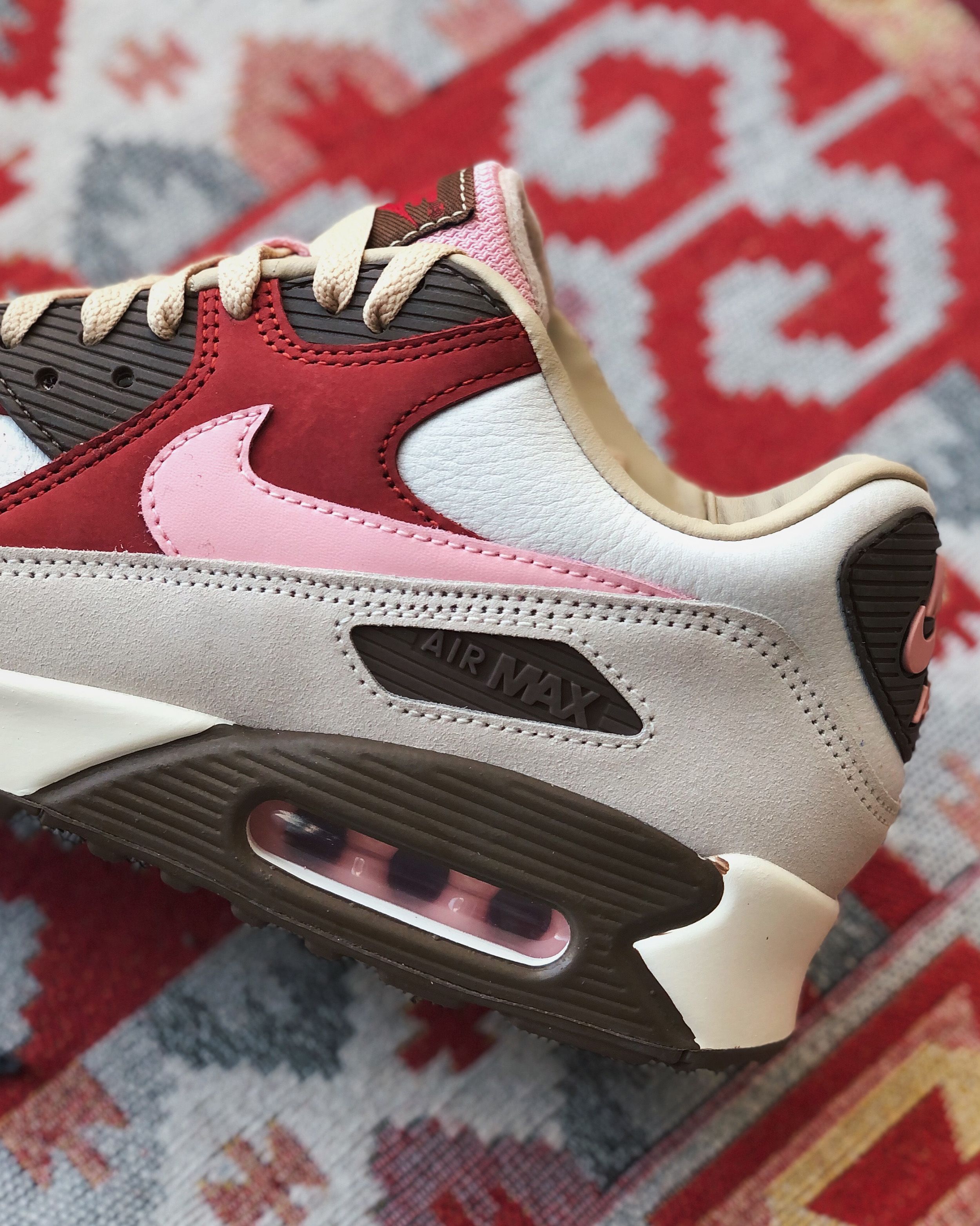.jpg?w=1920&h=2402&auto=format)
RELEASED: 2010
The Parra x Patta x Nike Air Max 1 “Cherrywood” represents a key moment in early collaborative storytelling, bringing together two of Amsterdam’s most influential creative forces. Built on a rich burgundy base, the pair is accented with Parra’s signature graphic style, introducing playful, abstract elements that contrast the otherwise classic Air Max 1 framework.
Rather than relying on broad themes, the design feels rooted in the local scene that both Parra and Patta helped shape. The execution is expressive without being overwhelming, striking a balance between artistic input and wearable design—something that would go on to define many of the most respected Air Max collaborations that followed.

Released: 2018
The OFF-WHITE x Nike Air Max 97 “Serena Williams” stands as one of the more refined entries from Virgil Abloh’s broader partnership with Nike, created as part of the “Queen” collection celebrating Serena Williams’ impact on and off the court.
Abloh’s signature touches remain present throughout, including exposed stitching, printed text, and a translucent Swoosh that blends into the upper. Subtle hits of gradient color appear along the midfoot striping, while a tinted Air unit underfoot adds a slight shift in tone. The result is a collaboration that balances OFF-WHITE’s deconstructed language with a touch of brillance and power that Serena brought to the court.

RELEASED: 2024
Kids of Immigrants approached the Air Max Sunder with intent beyond product. The Los Angeles-based collective has always centered its work around identity, belonging, and community — themes rooted in first-generation experiences. Their take on the Sunder leaned into bold messaging and graphic storytelling, giving new life to a lesser-seen silhouette. It wasn’t just about reviving an archive model; it was about reframing it through lived experience, adding cultural weight to Nike’s broader catalog

RELEASED: 2003
The “Viotech” Nike Air Max 1 saw atmos revisit one of Nike’s recognizable Dunk color palettes just one year after it released, and apply it to the Air Max 1 with a refined execution. The pair combines a mix of rich purples, oranges, reds, and blues across premium suede panels, creating a bold yet balanced composition that avoids feeling overly chaotic.
Rather than overcomplicating the concept, the Tokyo-based retailer allowed the color blocking to carry the design, reinforcing its reputation for understanding how to make statement palettes wearable. In doing so, the “Viotech” stands as another example of atmos’ long-standing influence on the Air Max 1 and the broader Nike Air Max shoes lineage.

RELEASED: 2025
Corteiz’s collaboration on the Air Max 95 marked one of the more notable full-circle moments in recent sneaker history. Before partnering with Nike, Clint419 and his brand had openly challenged the Swoosh — a legal dispute over name similarity to their 'Cortez' trademark that positioned Corteiz as an outsider pushing against the system. That tension made the eventual collaboration feel earned rather than expected.
When the project finally arrived, it stayed true to Corteiz’s identity. The Air Max 95 was delivered in military-inspired colorways with subtle branding and limited distribution, reinforcing the label’s community-first approach. Drops were intentionally controlled, often tied to location-based releases that required participation rather than passive consumption. In doing so, Corteiz didn’t just release a sneaker — it reintroduced the Air Max 95 to a new generation, proving that cultural relevance can be built from the ground up.

RELEASED: 2005
The Kidrobot x Nike Air Max 1 launched in 2005, when sneaker collaborations were still evolving, particularly at the intersection of streetwear, art, and toy culture. Known for its influence in the designer vinyl scene, Kidrobot brought a more graphic-heavy, character-driven approach to the Air Max 1, moving away from traditional color blocking in favor of bold illustrations and layered textures. The result felt closer to a collectible piece of art than to a conventional sneaker, reflecting the brand’s creative identity.
While it didn’t follow the now-familiar blueprint of storytelling-led collaborations, the project played an early role in pushing Nike Air Max shoes into more expressive territory. In hindsight, it helped lay the groundwork for the kind of artist-driven partnerships that would later become central to the Air Max line.


RELEASED: 2022
Concepts has consistently treated the Air Max 1 as a storytelling platform rather than just a product. Known for projects like the “Lobster” series and other narrative-driven releases, the Boston-based retailer builds out full concepts that extend beyond the shoe itself — from packaging to rollout strategy. Their rock-fest-inspired Air Max collaborations reflect that same approach, using materials, themes, and execution to create a complete experience of the late 60's rock era. It’s a reminder that the best collaborations don’t just release footwear — they build context around it.

RELEASED: 2019
Cactus Plant Flea Market’s take on the VaporMax felt right at home on one of Nike’s most unconventional silhouettes. Known for its playful, exaggerated approach, CPFM leaned into asymmetry, oversized branding, and unpredictable design choices. The result wasn’t a refinement of the shoe — it was an amplification of its wildest traits, making it one of the most distinct interpretations in the Air Max lineage.

RELEASED: 2006
Stash’s Air Max 95 leaned into his signature use of blue tones, delivering a clean and cohesive color story rooted in graffiti culture. Rather than relying on heavy branding, the design allowed color and material to carry the concept. With later, untrue-to-OG retros, the original still holds weight within the Air Max 95 Big Bubble conversation, standing as one of the most respected executions of the silhouette.

Nike Air Max has always been rooted in innovation, but its longevity has just as much to do with reinterpretation. From performance running shoes to global cultural staples, the line has continued to evolve without losing its identity.
As Air Max Day continues to anchor the calendar each March, these collaborations stand as markers of progression — not just for the product, but for the culture surrounding it.
SHOP AIR MAX ON NIKE.COM
Loading Next Article

